
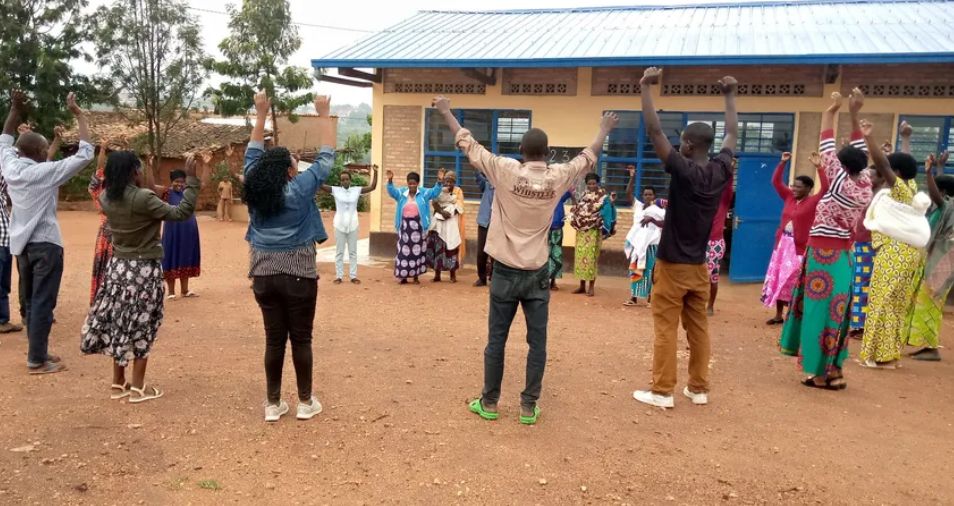
Continuing our series of articles from our Annual Report 2025/26, we outline here our work on our Young Survivors Entrepreneurship Project.
More than three decades after the 1994 Genocide against the Tutsi, many young survivors in Rwanda continue to live with the long-term social, emotional, and economic consequences of the tragedy. Poverty, limited access to education and employment opportunities, and the loss of family support systems have made it difficult for many survivors to secure stable livelihoods through conventional employment pathways.
In this context, entrepreneurship is not simply a means of income generation it is a pathway to dignity, resilience, and self-reliance. By equipping young genocide survivors with practical business skills, financial literacy, and access to start-up capital, entrepreneurship enables them to create their own opportunities in environments where formal employment remains limited. Small businesses generate income for individuals while also contributing to community development, job creation, and local economic recovery.
Entrepreneurship also plays a critical psychosocial role. Engaging in productive work, setting goals, and experiencing business success help restore confidence, purpose, and hope. For many survivors, this process supports healing by shifting their identity from vulnerability to agency and leadership within their communities.
Promoting entrepreneurship among young genocide survivors is therefore both an economic and a social intervention. It strengthens long-term resilience, enhances community stability, and empowers survivors to actively shape a more secure and prosperous future for themselves and for Rwanda as a whole.
With the support of Network for Africa (N4A), Survivors Fund has been able to implement an entrepreneurship training programme designed to equip young survivors with the skills needed to responsibly access and utilize loans while implementing viable business ideas.
At the start of the programme, N4A established a loan guarantee fund of 5,000,000 Rwf in partnership with Goshen Finance. This fund enables young genocide survivors to access loans without the need for traditional collateral. We sincerely appreciate Goshen Finance for their willingness to utilise and leverage this guarantee fund to support vulnerable young entrepreneurs.
Between 2022 and 2025, 989 young survivors who completed the peer counselling programme also successfully completed entrepreneurship training covering key business and financial topics.
During the year, 70 beneficiaries applied for microloans and 40 were approved, with a total value of RWF 20,000,000 (£10,220). Ninety-four beneficiaries started a business and 29 secured employment. Since the Goshen microfinance scheme began in 2022, a total of RWF 40,500,000 (£20,695) has been disbursed. The link between mental health and livelihoods remains clear: at the start of the programme, 70% of participants said mental health difficulties often prevented them from working or earning an income; by the end of the year, 73% said this was no longer the case, while only 3% said they still faced this barrier.
KF, Young Survivor *
“I don’t even know how to express my gratitude for this project. I finished high school very late because of the mental health challenges I faced for many years related to the genocide. I lost my parents and siblings during the 1994 Genocide against the Tutsi and survived alone as the only survivor in a family of seven.
“After the genocide, I attempted suicide several times, but I survived. I joined a peer counselling group thinking it would be a waste of time, as I just didn’t want to stay home alone. However, things began to change from the very first day. We learned many topics, including how to rebuild our lives and plan for the future.
“After six months, we received entrepreneurship training. I later took a loan of 500,000 Rwf from Goshen and started a sewing business, building on skills I already had. Today, I earn a stable income from my business, my life has completely changed, and I no longer struggle with suicidal thoughts. My long-term goal is to open a shop in my community. My monthly income ranges between 50,000 and 70,000 Rwandan francs after expenses.”
MC, Young Survivor *
“Through the peer counselling group, my family life changed completely. I did not have the opportunity to go to school because I was responsible for caring for my younger siblings after our parents were killed during the genocide. I worked hard to provide food for them while ensuring they attended school.
“After they completed high school, I got married and later had two children. Unfortunately, my marriage became abusive, which worsened my mental health, and we eventually divorced. I struggled greatly to provide for my children.
“After joining the peer counselling group, I received mental health support and later attended entrepreneurship training, where I learned financial literacy and small business management. Taking a loan from Goshen was one of the hardest decisions I had ever made, but it transformed my life. I started a business trading crops in the local market, repaid the loan, and began saving.
“Today, I can meet my family’s basic needs without depending on others or local authorities. My business is progressing well, my children attend school regularly, and I have regained my self-confidence and dignity.”