
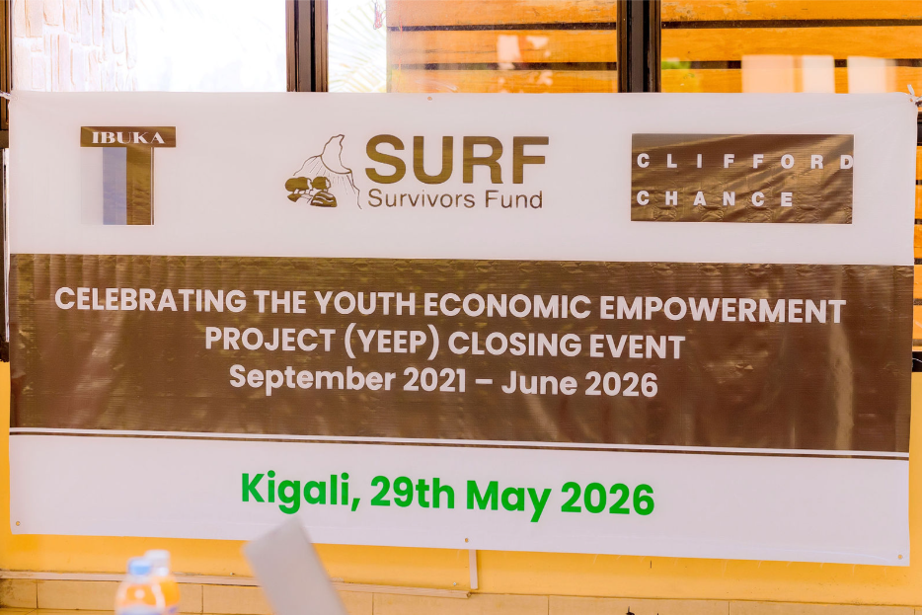
Since 2019, Clifford Chance has stood behind SURF through its Cornerstone Initiative, a remarkable six-year commitment that has touched the lives of tens of thousands of genocide survivors and their families across Rwanda. As the initiative has concluded, we want to take this opportunity to look back on what their funding has achieved, and to say an enormous thank you to everyone at Clifford Chance who made this work possible.
The Youth Economic Empowerment Project (YEEP), ran from July 2021 to June 2026 and helped young survivors build sustainable livelihoods through entrepreneurship training, vocational courses, work readiness support and internships. By the time it concluded, YEEP had reached 7,329 genocide survivors and family members, many of whom have since started businesses, secured formal employment, or gained the confidence and skills to support themselves and their families for the first time.
For many young survivors of the genocide against the Tutsi, and for the children born into survivor families since, unemployment has compounded the trauma of the past. A survey of members of the National Student’s Association of Genocide Survivors (AERG), now part of IBUKA, found that 88% said their mental state affected their ability to work, while national youth unemployment stood at 20% at the project’s outset. The COVID-19 pandemic made things harder still, closing the hotels, restaurants and shops where many young people had hoped to find their first jobs.
YEEP was designed to change that. Between July 2021 and June 2026, SURF and AERG delivered a four-pronged programme of entrepreneurship training, vocational courses, work readiness training and an internship scheme, tailored to young survivors who had dropped out of school or faced particular barriers to employment. Where appropriate, participants were supported to apply for loans through SURF’s microfinance partner, Urwego Bank, or to join existing community savings groups.
The results speak for themselves. Marie-Claire Kanyumba, who had been working as a hospital cleaner and could not always afford more than one meal a day, learned to sew through YEEP and, with support to buy her own machine, built a tailoring business that now covers all her family’s basic needs. Jean-Pierre Kwizera used a loan of RWF 400,000 to start a business now worth RWF 6 million, which has gone on to employ two other people.
“My goal is to keep working hard so that I can thrive, build a good house and have a healthy family.” Jean-Pierre Kwizera, YEEP participant
In total, YEEP supported 7,329 genocide survivors and family members with entrepreneurship training, work readiness training, an internship programme and vocational training – leaving a lasting legacy of skills, confidence and independence.
You can read the full report here.
And view a short film on some of the success stories here.