
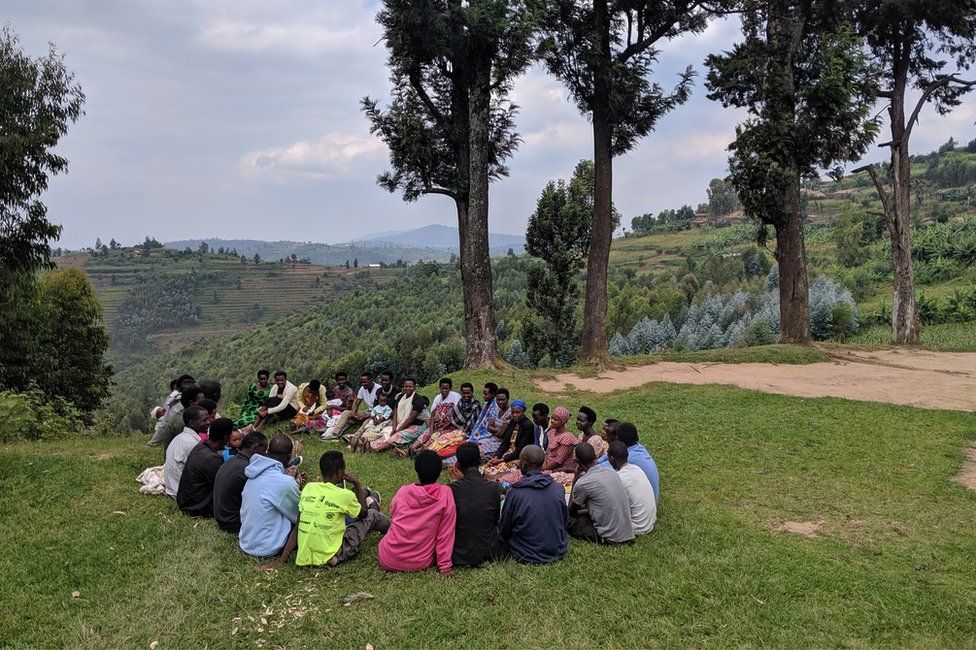
Continuing our series of articles from our Annual Report 2025/26, we outline here our work on our Peer Counselling Programme.
SURF’s peer counselling programme, funded and delivered in partnership with Network for Africa, supports around 300 survivors of the Genocide against the Tutsi in Rwanda every year to address their PTSD disorder by providing a structured and safe environment where they can share their trauma and experiences.
Participants are selected through partnerships with organisations including AVEGA (National Association of Genocide Widows) and AERG (National Student’s Association of Genocide Survivors) to ensure priority access for those most in need.
In January 2025, 276 survivors (195 women and 81 men from Huye and Rwamagana districts were enrolled. They formed 12 peer counselling groups and elected 24 participants to become peer support counsellors (PSCs), who moderate and lead the fortnightly group counselling sessions, follow up on participants who experience particular difficulties and refer more complicated cases for extra support to SURF’s counsellors. During the year a total of 264 group counselling sessions and 830 individual sessions were delivered. Counsellors carried out 82 home visits and peer support counsellors conducted a further 215, offering family therapy, conflict resolution and psychoeducation. Between them, they also helped resolve 35 family and community conflicts, including disputes linked to property, relationships, alcohol misuse and neglect of responsibilities. Attendance across the year remained high, averaging 92%.
In 2025, we ran peer counselling groups for older survivors as well to address PTSD, depression, anxiety and isolation and to introduce coping mechanisms for age related challenges; strengthen support networks and promote intergenerational healing and reconciliation. The group meetings provided much needed social interaction, and the participants are now running small businesses and have started savings schemes. Bringing the older group together with the younger groups has facilitated dialogue and reconciliation, by providing a platform for elders to share their experiences with younger survivors and assist in rebuilding broken relationships. It has fostered greater intergenerational understanding and empathy, with the younger genocide survivors visiting the elders, assisting them with their vegetable gardens and other household chores. The initiative has proved highly successful.
April 2025 marked the 31st Anniversary of the 1994 Genocide against the Tutsi in Rwanda. SURF carried out awareness raising in secondary schools to prepare second-generation survivors for the start of the commemoration period and to share information about counselling services. The commemoration events triggered traumatic episodes for 35 participants, who all recovered, through counselling.
After some months of meeting in their peer counselling groups the participants became more involved in their local communities and the lives of their peers. In 2025 they assisted fellow group members with 50 small community work projects such as building latrines, planting vegetable/kitchen gardens, assisting with harvests and renovating kitchens. They also visited each other in their homes to support those who were lonely. These are all things that receive no government support, and this sense of community is something that the participants had not experienced before.
In order to be able to measure impact, a baseline and end-of-year survey of 60 participants was carried out at the start and end of 2025. The outcomes were striking. By the end of the year, the proportion of participants reporting isolation had fallen from 82% to 19%. Reports of depression fell from 100% to 51%, while suicidal thoughts fell from 87% to 3%. These are significant results, particularly given the long-term and complex trauma many participants carry.
Training and supervision remained central to delivery. The 24 peer support counsellors received training in trauma counselling and in leading peer groups effectively, and SURF’s counsellors provided four rounds of clinical supervision during the year. Community-facing work also remained important. Four psychoeducation sessions in secondary schools in Huye reached 607 young people, and during the 31st commemoration of the 1994 Genocide against the Tutsi, 36 beneficiaries experienced trauma crises but all recovered with support from SURF’s counsellors.
Community feedback was given by local government representatives who thanked SURF for bringing young survivors together and expressed appreciation for the progress they have made in learning to be independent. They noted that the peer group counselling services assisted in reducing family conflict and supporting national development.
Participants said that the peer counselling programme had brought them together, helped them learn how to save money and problem solve. They are grateful for socialising with their peers because they no longer feel alone. They have learnt to manage and control their emotions, which helps them to think positively. Some peer counselling group members have been elected to local government positions, having found the confidence to put themselves forward. The PSCs are grateful for the support they have received for overcoming loneliness, which has built their self-confidence and enabled them to become role models in their communities.
SURF brought over 1,000 community members together during 2025, to raise awareness about mental health issues.
U *
U is a 32-year-old single mother and a genocide survivor living in Huye District. She has a two-year-old child. In 2016, she completed Senior Six (S6) in Computer Science. She was born into a family of four children, two boys and two girls, of which she is the youngest. Her father and two older brothers were killed during the 1994 Genocide against the Tutsi. She survived together with her mother and sister.
Her psychological difficulties were mainly related to grief following the loss of her mother and depression caused by deception of her husband. In 2017, her mother became ill and later passed away. U was deeply affected by her mother’s death, especially as her mother died while she was with her in the hospital during treatment. Following this loss, U became severely depressed, felt rejected, experienced insomnia and frequent headaches, and reported feelings of hatred toward others. She also had recurrent thoughts of suicide and death, as she felt uncertain about where and how she would live.
At that time, neither she nor her older sister was employed. They supported each other, as their mother had been the family’s main provider through farming. After her mother’s death, U began learning farming activities and continued living under difficult conditions.
In 2023, she fell in love with a neighbour who promised to live with her and build a family together. However, after she became pregnant, he rejected her and moved to Kigali. She gave birth under very challenging circumstances. Her sister, who works at a health centre, provided support to her and the baby.
U presented as quiet and sad, expressed self-blame related to the unplanned pregnancy, and felt she had become a burden to her sister. She reported insomnia, frequent headaches, and symptoms consistent with depression.
U received both group and individual counselling focused on grieving the death of her mother and family members lost during the Genocide, as well as accepting other negative life events. Through activating positive resources such as valuing her life, stress reduction techniques, relaxation exercises, problem-solving skills, stress management, and embracing healing-focused practices she was able to strengthen her coping abilities.
Currently, her condition has improved. She has changed her negative thought patterns and started searching for employment. She has now secured a job and is working toward a better future